Exam Patterns and Syllabus
CLAT 2026
- Sections: Logical Reasoning (40 questions), English (40), GK (35), Quantitative Techniques (10), Legal Aptitude (35) .
- Structure: Tiered system (General/SC/ST/OBC) with negative marking (-0.25 per incorrect answer).
- Key Focus: Legal Aptitude section tests understanding of legal principles and cases.
For any queries regarding CLAT online classes, reach out to us at +91-9303019139 or +91-9929774737
Book One to One Clat Mentorship

AILET 2026
- Sections: English (30), Legal GK (30), Logical Reasoning (30), Quantitative Aptitude (10) .
- Structure: Tiered system (General/SC/ST/OBC) with negative marking (-0.25 per incorrect answer).
- Key Focus: Legal GK covers Indian legal system, landmark judgments, and current legal issues.
SLAT 2026
- Sections: Legal Reasoning (40), Logical Reasoning (30), English (30), Quantitative Aptitude (20), and General Knowledge (30) .
- Structure: Tiered system based on academic performance (10 CGPA tiers).
- Key Focus: Legal Reasoning includes case analysis and legal principles.
DU LLB 2026
- Structure: Merit list based on Class 12 marks (60% weight) + Written Test (30%) + Interview (10%) .
- Key Focus: Interview assesses communication skills and logical reasoning.
Eligibility Criteria
Exam | Minimum Age | Maximum Age | Academic Qualification |
CLAT 2026 | 17 years | 25 years | 45% in Class 12 (50% for reserved categories) |
AILET 2026 | 17 years | 25 years | 50% in Class 12 (45% for reserved categories) |
SLAT 2026 | 17 years | 25 years | 55% in Class 12 (50% for reserved categories) |
DU LLB 2026 | 17 years | 25 years | 60% in Class 12 (55% for reserved categories) |
Cutoff Trends (2021–2024)
Exam | 2021 Cutoff | 2022 Cutoff | 2023 Cutoff | 2024 Cutoff |
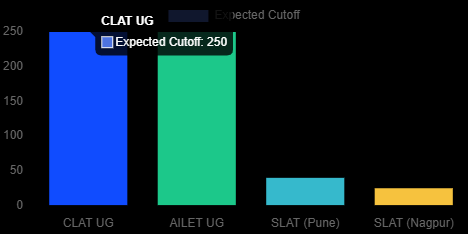
CLAT | 117 | 132 | 141 | 145 |
AILET | 65 | 70 | 75 | 80 |
SLAT | 108 | 115 | 122 | 128 |
DU LLB | 95% | 97% | 98% | 99% |
Selection Process
1. CLAT/AILET/SLAT:
- Written test followed by interview (CLAT/SLAT) or direct merit (AILET).
- Negative marking in all sections except DU LLB.
2. DU LLB:
- Written test (MCQs) + Interview.
- No negative marking; emphasis on academic consistency.
Key Differences
- Legal Aptitude: CLAT and SLAT prioritize legal reasoning, while AILET focuses on GK.
- Competition: CLAT and SLAT have higher cutoffs due to elite college affiliations (NLU campuses, SLS Pune).
- Interview Weightage: DU LLB’s interview (10%) is less critical than CLAT/SLAT (20%–30%).
Affiliated Universities
- CLAT: 21 NLUs (e.g., NLU Delhi, Bangalore).
- AILET: Amity Law School, Noida.
- SLAT: Symbiosis Law School, Pune.
- DU LLB: Delhi University colleges (e.g., Hans Raj, Hindu College).
Final Recommendations
- High Academic Performers: Opt for CLAT (top NLUs) or DU LLB (prestige).
- Strong Legal Aptitude: SLAT offers a mix of theoretical and practical testing.
- Balanced Preparation: AILET is suitable for candidates with moderate preparation.