This article covers:
5 Writs of the Indian Constitution Constitutional Basis of Writ Jurisdiction What is a Writ? 1. Habeas Corpus 2. Mandamus 3. Certiorari 4. Prohibition 5. Quo Warranto Summary Table of 5 Writs Difference Between Article 32 and Article 226 Importance of Writs in Indian Democracy Writs for CLAT, Judiciary & UPSC Exams Frequently Asked Questions (FAQs) Conclusion |
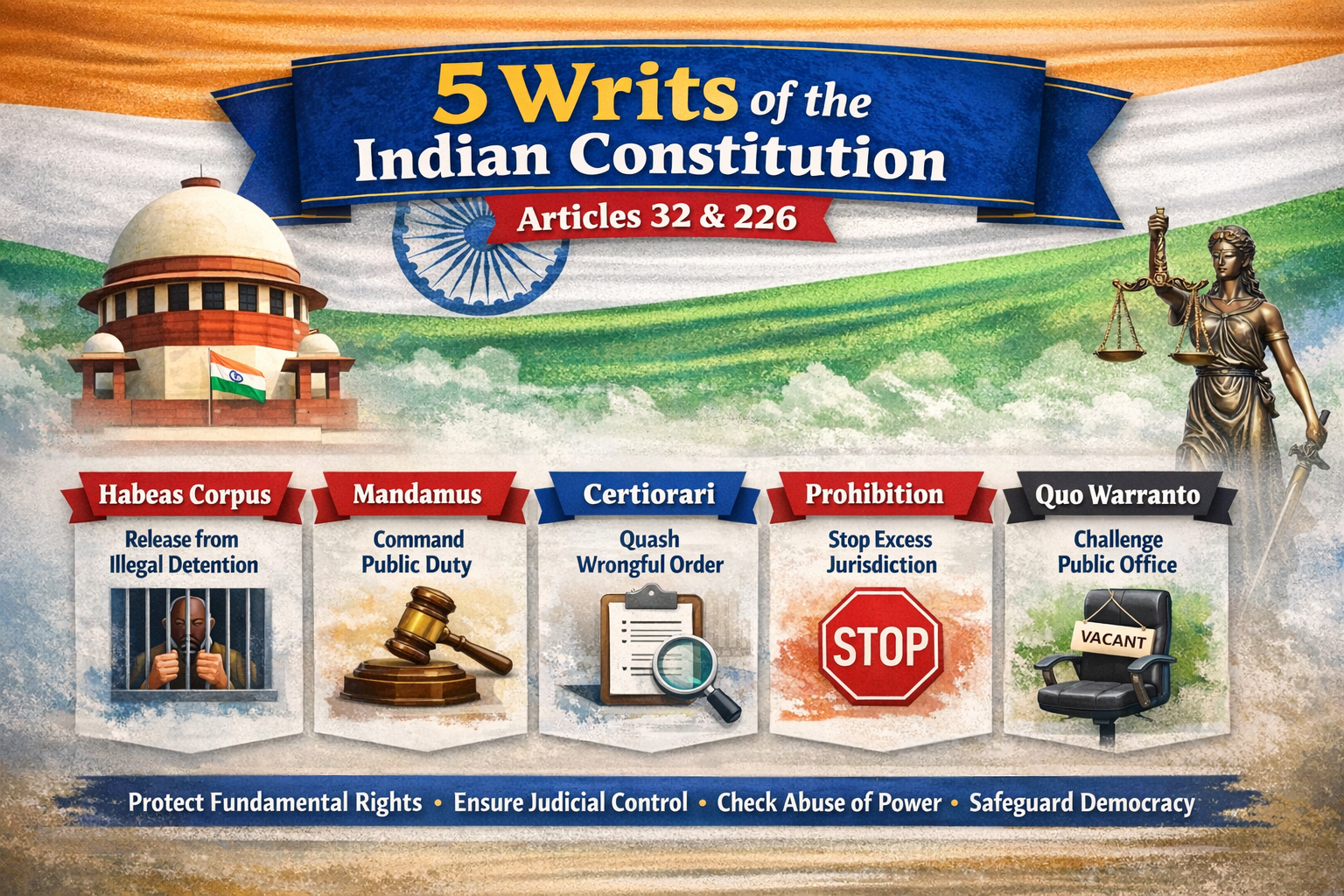
The 5 Writs of the Indian Constitution are powerful constitutional remedies that protect Fundamental Rights and ensure judicial control over administrative actions. These writs are issued by the Supreme Court under Article 32 and by the High Courts under Article 226 of the Constitution of India.
Understanding writs is essential for:
- Law entrance exams (CLAT, AILET)
- Judiciary exams
- UPSC Polity
- Law school exams
- Constitutional law studies
In this article, we cover the meaning, constitutional provisions, scope, differences, and landmark case laws related to all five writs.
Constitutional Basis of Writ Jurisdiction
Article 32
- Right to move Supreme Court for enforcement of Fundamental Rights
- Called the “Heart and Soul” of the Constitution by Dr. B.R. Ambedkar
Article 226
- High Courts can issue writs for:
- Enforcement of Fundamental Rights
- Any other legal right
What is a Writ?
A writ is a formal written order issued by a court directing a person or authority to perform or refrain from performing a specific act.
The five types of writs in India are:
- Habeas Corpus
- Mandamus
- Certiorari
- Prohibition
- Quo Warranto
1. Habeas Corpus
Meaning:
“Habeas Corpus” means “You may have the body.”
Purpose:
To secure release of a person who has been illegally detained.
When is it Issued?
- Illegal arrest
- Unlawful detention
- Violation of personal liberty (Article 21)
Who Can File?
- The detained person
- Family member
- Any concerned individual (PIL allowed)
Landmark Cases:
- ADM Jabalpur v. Shivkant Shukla (1976)
- K.S. Puttaswamy v. Union of India (2017)
Habeas Corpus is considered the most important writ as it protects Right to Life and Personal Liberty under Article 21.
2. Mandamus
Meaning:
“Mandamus” means “We Command.”
Purpose:
To command a public authority to perform a public or statutory duty.
Issued Against:
- Public officials
- Government departments
- Statutory bodies
- Lower courts
Cannot Be Issued Against:
- Private individuals
- President or Governor (for constitutional duties)
- Judicial bodies acting in judicial capacity
Landmark Case:
- State of West Bengal v. Nuruddin (1998)
Mandamus ensures accountability of public authorities.
3. Certiorari
Meaning:
“Certiorari” means “To be informed” or “To certify.”
Purpose:
To quash an order passed by a lower court or tribunal if:
- It acted without jurisdiction
- Exceeded its jurisdiction
- Violated principles of natural justice
- Committed an error of law
Issued By:
- Supreme Court
- High Courts
Landmark Case:
- T.C. Basappa v. T. Nagappa (1954)
Certiorari corrects errors after the decision has been made.
4. Prohibition
Meaning:
“To prohibit” or “To stop.”
Purpose:
Issued to prevent a lower court or tribunal from exceeding its jurisdiction.
Key Difference from Certiorari:
Prohibition ensures lower courts do not act beyond legal authority.
5. Quo Warranto
Meaning:
“By what authority?”
Purpose:
To question the legality of a person’s claim to a public office.
Conditions:
- Office must be public
- Office must be created by statute
- Person must not be legally qualified
Landmark Case:
- University of Mysore v. C.D. Govinda Rao (1964)
Quo Warranto promotes transparency and prevents illegal occupation of public office.
5 Writs under Indian constitution video explanation
Summary Table of 5 Writs
Difference Between Article 32 and Article 226
Importance of Writs in Indian Democracy
The writ system ensures:
- Rule of Law
- Protection of Fundamental Rights
- Judicial Review
- Accountability of government authorities
- Check on misuse of power
Writ jurisdiction strengthens constitutional governance and protects citizens from arbitrary state action.
Writs for CLAT, Judiciary & UPSC Exams
For exam purposes, remember:
- Article 32 → Supreme Court
- Article 226 → High Courts
- Habeas Corpus → Personal Liberty
- Mandamus → Public Duty
- Certiorari & Prohibition → Judicial control
- Quo Warranto → Public office validity
Frequently Asked Questions (FAQs)
1. How many writs are there in the Indian Constitution?
- There are five writs: Habeas Corpus, Mandamus, Certiorari, Prohibition, and Quo Warranto.
2. Which Article deals with writs?
- Article 32 (Supreme Court) and Article 226 (High Courts).
3. Which writ protects personal liberty?
- Habeas Corpus.
4. Can writs be issued against private individuals?
- Generally no, except Habeas Corpus in certain circumstances.
5. Which writ is issued before the decision of a lower court?
- Prohibition.
6. Which writ is issued after the decision?
- Certiorari.
7. Who called Article 32 the heart and soul of the Constitution?
- Dr. B.R. Ambedkar.
Conclusion
The 5 Writs of the Indian Constitution are powerful constitutional tools that safeguard democracy, enforce Fundamental Rights, and maintain judicial control over public authorities. Articles 32 and 226 form the backbone of India’s constitutional remedy framework.
For law aspirants, judiciary students, and competitive exam candidates, understanding writs is essential for scoring high in Constitutional Law and Polity