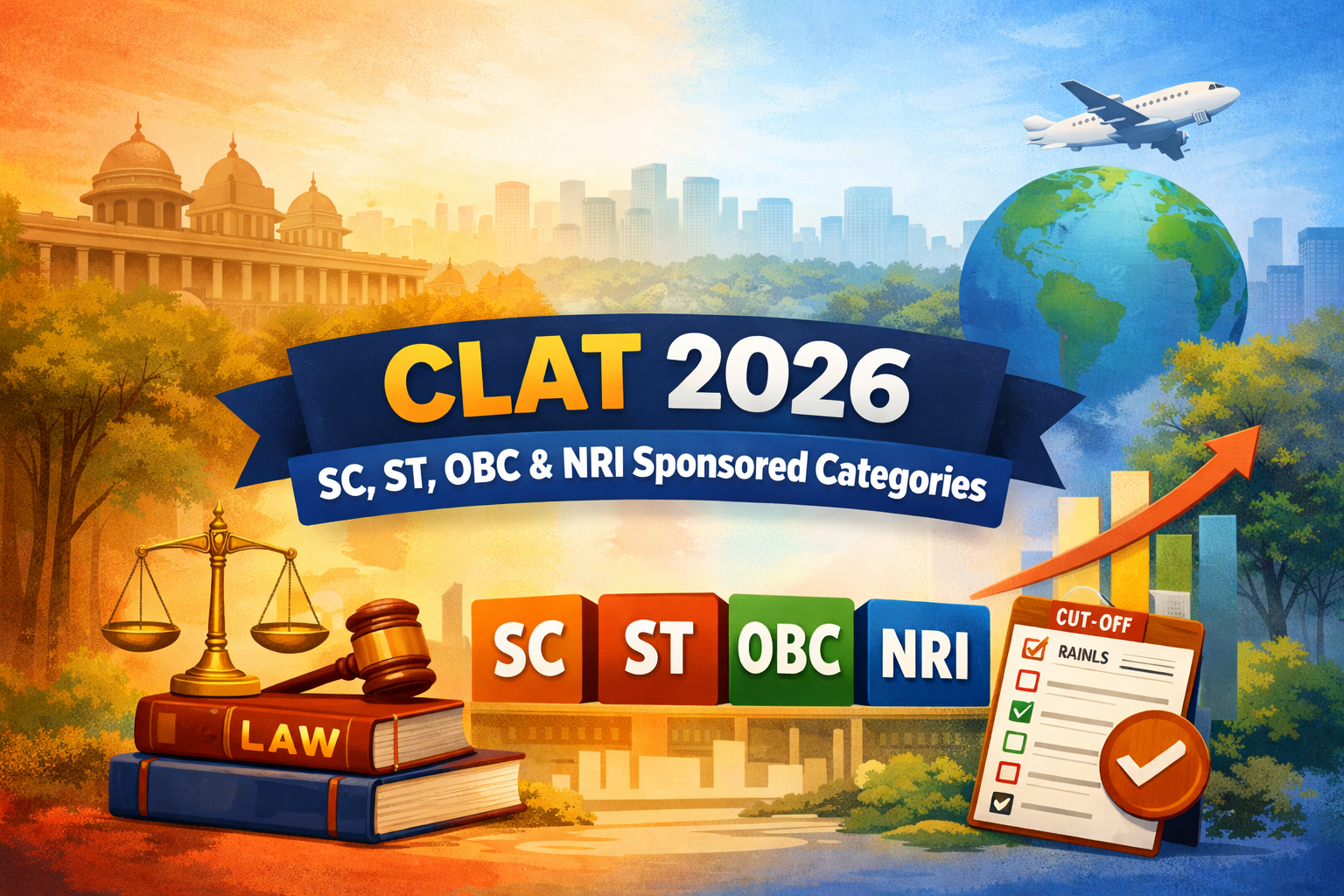
The Common Law Admission Test (CLAT) is the primary entrance exam for admission into undergraduate and postgraduate law programs offered by National Law Universities (NLUs) in India. One of the most important aspects of the CLAT admission process is the reservation policy, which ensures representation of historically disadvantaged communities and specific categories such as SC, ST, OBC, and NRI Sponsored candidates.
Understanding these categories is crucial for aspirants because seat distribution, cutoffs, and eligibility criteria vary significantly across categories. This article explains the SC, ST, OBC, and NRI Sponsored categories using CLAT 2026 data, helping students better understand their chances during the counselling process.
This article covers:
Overview of CLAT 2026 Seat Distribution SC Category in CLAT 2026 ST Category in CLAT 2026 OBC Category in CLAT 2026 NRI Sponsored Category in CLAT 2026 CLAT 2026 Category wise cutoffs Safe score band for each category How Reservation Categories Affect CLAT Cutoffs Conclusion FAQs |
Overview of CLAT 2026 Seat Distribution
In CLAT 2026, approximately 3,700 seats were available across all participating NLUs for undergraduate law programmes. These seats are distributed among different reservation categories according to constitutional provisions and institutional policies.
Each NLU follows its own reservation policy, but most institutions broadly include the following categories:
- Scheduled Castes (SC)
- Scheduled Tribes (ST)
- Other Backward Classes (OBC)
- Economically Weaker Sections (EWS)
- Persons with Disabilities (PwD)
- NRI / NRI Sponsored
- State Domicile quotas
Among these, the SC, ST, OBC, and NRI Sponsored categories play a major role in CLAT admissions.
SC Category in CLAT 2026
The Scheduled Caste (SC) category reservation is provided under Article 15(4) and Article 16(4) of the Constitution of India. Most NLUs reserve approximately 15% of seats for SC candidates.
For example:
- At NALSAR Hyderabad, around 14 seats in the All-India quota are reserved for SC candidates in the undergraduate programme.
- Several NLUs also combine SC reservation with domicile quotas, increasing the chances of admission for students belonging to the host state.
Key Features of SC Category in CLAT
- Usually around 15% reservation across NLUs
- Requires a valid SC caste certificate
- Cutoff ranks are generally lower than the General category
CLAT Cutoff 2025 Category-Wise Analysis
ST Category in CLAT 2026
The Scheduled Tribe (ST) category also benefits from constitutional reservation policies aimed at promoting social justice and educational inclusion.
Most NLUs reserve around 7.5% seats for ST candidates.
For example:
- At NALSAR Hyderabad, 8 seats are reserved for ST candidates in the All-India category.
- Some universities such as HNLU Raipur also provide state domicile reservation for ST candidates, especially in states with higher tribal populations.
Key Features of ST Category
- Approximately 7.5% reservation
- Lower cutoffs compared to General and OBC categories
- Domicile quotas may significantly improve chances of admission
Top NLUs Accepting CLAT Scores
OBC Category in CLAT 2026
The Other Backward Classes (OBC) category provides reservation to socially and educationally backward communities.
However, there are some important aspects to understand:
- OBC reservation varies across NLUs
- Many universities apply Central OBC Non-Creamy Layer (NCL) criteria
- Some NLUs also combine OBC reservation with domicile quotas
For example:
- NALSAR Hyderabad reserves around 18% to 29% seats for OBC candidates in its undergraduate programme.
Important Requirements for OBC Reservation
- Valid OBC Non-Creamy Layer certificate
- Issued by a competent authority
- Must comply with Central Government guidelines
NRI Sponsored Category in CLAT 2026
The NRI / NRI Sponsored category is a special admission category offered by many NLUs.
Unlike constitutional reservations, these seats are typically supernumerary seats, meaning they are in addition to the regular intake.
For example:
- NUJS Kolkata offers around 20 NRI/NRI Sponsored seats in its BA LL.B programme.
- NLU Jodhpur offers around 16 seats under the NRI category.
Eligibility for NRI Sponsored Category
Candidates must meet one of the following criteria:
- Be an NRI, OCI, or PIO card holder
- Be sponsored by a first or second-degree relative who is an NRI
Key Features
- Separate fee structure (usually much higher)
- Admission based on CLAT rank
- Seats available only in select NLUs
CLAT 2026 Category wise cutoffs
Safe score band for each category
How Reservation Categories Affect CLAT Cutoffs
Reservation policies directly influence CLAT cutoff ranks and admission chances.
Key factors affecting cutoffs include:
- Number of seats in each category
- Difficulty level of the CLAT exam
- Number of applicants in a category
- State domicile quotas
- NLU-specific reservation policies
Generally:
- General category has the highest cutoff
- OBC category has moderate cutoffs
- SC/ST categories have comparatively lower cutoffs
Conclusion
The SC, ST, OBC, and NRI Sponsored categories in CLAT 2026 play a crucial role in shaping admission opportunities across National Law Universities. Understanding how these reservations work can help aspirants:
- Predict their admission chances
- Make better NLU preference lists
- Prepare a smarter counselling strategy
Before applying, students should carefully review the seat matrix and reservation policy of each NLU, as these policies differ across universities.
FAQs
1. What is the reservation percentage for SC and ST in CLAT?
Most NLUs follow the 15% reservation for SC and 7.5% for ST candidates, although exact seat numbers vary by institution.
2. Is OBC reservation available in all NLUs?
No. Some NLUs provide OBC reservation based on central government rules, while others combine it with state domicile quotas.
3. What is the NRI Sponsored category in CLAT?
The NRI Sponsored category allows students sponsored by an NRI relative to apply for supernumerary seats in select NLUs.
4. Do NRI Sponsored candidates need a CLAT rank?
Yes. Most NLUs require a valid CLAT score even for NRI Sponsored admissions.
5. Does reservation affect CLAT cutoff?
Yes. Cutoffs vary by category because each category has a separate seat allocation and competition pool.