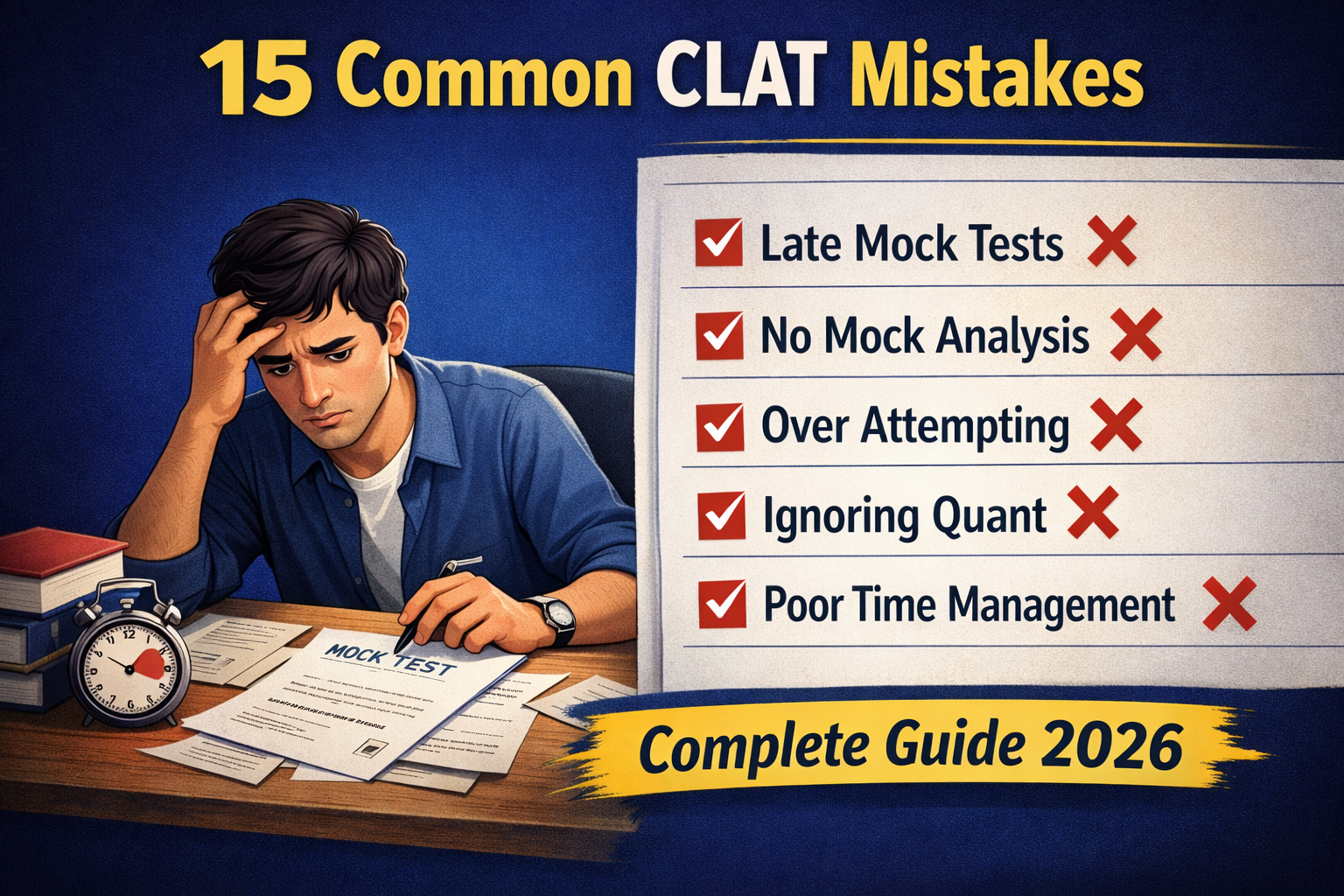
Why Avoiding Mistakes is Crucial in CLAT 15 Common Mistakes CLAT Aspirants Make Section-Wise Mistakes in CLAT How to Avoid These Mistakes FAQs |
Preparing for CLAT is not just about studying hard — it’s about studying smart. Every year, thousands of aspirants fall short not because they lack potential, but because they repeat common CLAT preparation mistakes.
If you want a top NLU rank, you must first understand what not to do.
This guide breaks down the most common mistakes CLAT aspirants make, why they hurt your score, and how to fix them.
Why Avoiding Mistakes is Crucial in CLAT
The exam is conducted by the Consortium of National Law Universities and is highly competitive. With the paper now comprehension-based and analytical, traditional rote-learning strategies no longer work.
Even small errors can cost 5–15 marks which can mean the difference between:
- National Law School of India University
- NALSAR University of Law
- National Law University Delhi (through AILET)
15 Common Mistakes CLAT Aspirants Make
1. Starting Mock Tests Too Late
Many students wait to “complete the syllabus” before attempting mocks.
Reality: CLAT has no fixed syllabus. It is skill-based.
Start mocks early (even if scores are low).
Use them as learning tools, not judgment tools.
How to Score 80+ in CLAT Mock Tests
2. Not Analysing Mocks Properly
Giving mocks without analysis is like practicing without feedback.
Common issues:
- Not reviewing wrong answers
- Ignoring time management
- Repeating the same mistakes
Maintain an error notebook.
Categorize mistakes (conceptual, careless, time pressure).
3. Ignoring Current Affairs Revision
Students read daily news but fail to revise systematically.
CLAT current affairs questions:
- Are passage-based
- Linked with static GK
- Focus on legal and constitutional developments
Revise last 10–12 months thoroughly.
Prepare monthly compilations.
Best Sectional Tests for CLAT Current Affairs
4. Over-Attempting Questions
Many aspirants attempt 115+ questions and lose heavily due to negative marking.
CLAT has -0.25 negative marking.
Target 100–105 smart attempts.
Maintain 85–90% accuracy.
5. Neglecting the Quantitative Section
Quant carries fewer questions but can boost your rank significantly.
Students often:
- Avoid practice
- Panic during DI sets
- Leave the entire section
Practice basic percentages, ratios, averages.
Solve 2 DI sets daily.
How to Prepare Quantitative Techniques for CLAT
6. Rote Learning Legal Theory
CLAT legal section tests:
- Application
- Logical reasoning
- Interpretation
Memorizing bare acts is not required.
Focus on principle-fact application.
Practice passage-based legal sets.
7. Poor Time Management
Many students:
- Spend too long on Legal
- Rush Current Affairs
- Leave Quant for last minute panic
Develop a fixed attempt order.
Practice sectional timing.
8. Ignoring Reading Speed
CLAT is a reading-heavy exam.
Without speed + comprehension:
- You won’t finish paper
- Accuracy drops
Read editorials daily (The Hindu / Indian Express).
Practice 4–5 RC passages daily.
9. Comparing Scores Without Context
Different mock series have different difficulty levels.
Track percentile improvement.
Focus on personal growth, not peer comparison.
10. Switching Study Material Frequently
Jumping between:
- Multiple coaching notes
- Random YouTube strategies
- Different mock series
This leads to confusion.
Stick to limited trusted sources.
Revise instead of accumulating material.
11. Ignoring Static GK
Static GK helps:
- In passage context
- In elimination
- In close options
Study constitutional articles, institutions, international bodies.
12. Practicing Only Easy Questions
Avoid comfort-zone preparation.
Attempt high-difficulty mock sets.
Challenge your reasoning ability.
13. No Revision Plan
Students keep learning new things but rarely revise.
Weekly revision schedule
Monthly CA revision cycle
14. Burnout Before Exam
Excessive study hours without breaks reduces efficiency.
Take weekly breaks.
Maintain sleep cycle.
15. Panic During the Exam
One tough passage can disrupt entire paper.
Skip and return strategy.
Stay emotionally neutral during mocks.
Section-Wise Mistakes in CLAT
English Language
- Focusing on vocabulary instead of comprehension
- Ignoring tone and inference questions
Legal Reasoning
- Adding external legal knowledge
- Not sticking to the passage
Logical Reasoning
- Assuming facts not mentioned
Current Affairs
- Reading without revising
Quantitative Techniques
- Avoiding calculation practice
How to Avoid These Mistakes
- Start mocks early.
- Analyse every mock.
- Maintain accuracy above 85%.
- Revise current affairs monthly.
- Improve reading habits.
- Track progress weekly.
Consistency beats intensity.
FAQs
1. What is the biggest mistake CLAT aspirants make?
Not analysing mock tests properly. This alone can cost 10–15 marks.
2. Is attempting all 120 questions a good strategy?
No. Smart attempts with high accuracy are safer.
3. How many mocks should I give before CLAT?
At least 35–50 full-length mocks with proper analysis.
4. Should I read bare acts for CLAT?
Not necessary. Focus on application-based practice.
5. How can I improve from 75 to 90 marks?
- Improve accuracy
- Strengthen Legal & Logical
- Revise current affairs properly
6. Is coaching mandatory to avoid mistakes?
No. With discipline, structured mock analysis, and proper planning, self-study can also lead to top ranks.
Conclusion
Most students don’t fail because they lack knowledge, they fail because they repeat avoidable mistakes.
If you:
- Analyse consistently
- Avoid over-attempting
- Strengthen reading skills
- Revise strategically
You can easily move into the 90+ range.