INDEX
CLAT PG 2026 Eligibility Criteria 1 CLAT PG 2026 Exam Pattern 1 Colleges Accepting CLAT PG 2026 Scores 2 CLAT PG 2026 Counselling and Admission Process 3 Why CLAT PG 2026 Matters for LL.M. Aspirants 3 |
TheCommon Law Admission Test for Postgraduate programmes (CLAT PG) 2026is the gateway to admission intoLL.M. programmes offered by National Law Universities (NLUs)across India. Conducted by theConsortium of National Law Universities, CLAT PG is one of the most competitive law entrance examinations for postgraduate legal studies.
This article provides a complete overview ofCLAT PG 2026 eligibility criteria, exam pattern, and the list of colleges, along with answers to frequently asked questions.
You may explore the CLAT PG 2026 Syllabus, Pattern and Sources here
CLAT PG 2026 Eligibility Criteria
To appear forCLAT PG 2026, candidates must satisfy the eligibility requirements prescribed by the Consortium of NLUs. The eligibility is uniform across all participating NLUs, although final admission is subject to university-specific rules.
- A candidate must possess anLL.B. degree (3-year or 5-year)from a recognised university or institution.
- General and OBC category candidates are required to have securedat least 50% aggregate marksin their qualifying examination. ForSC/ST/PwD candidates, the minimum required aggregate is45%.
- Candidates who areappearing in the final year of their LL.B. programmein 2025–26 are also eligible to apply, provided they submit proof of qualification at the time of admission.
(For category-wise relaxation rules and NLU-specific eligibility nuances, have a look at our detailed breakdown here – CLAT PG Eligibility Explained)
CLAT PG 2026 Exam Pattern
Understanding theCLAT PG 2026 exam patternis crucial for effective preparation as the postgraduate paper is conceptually demanding and analysis-oriented.
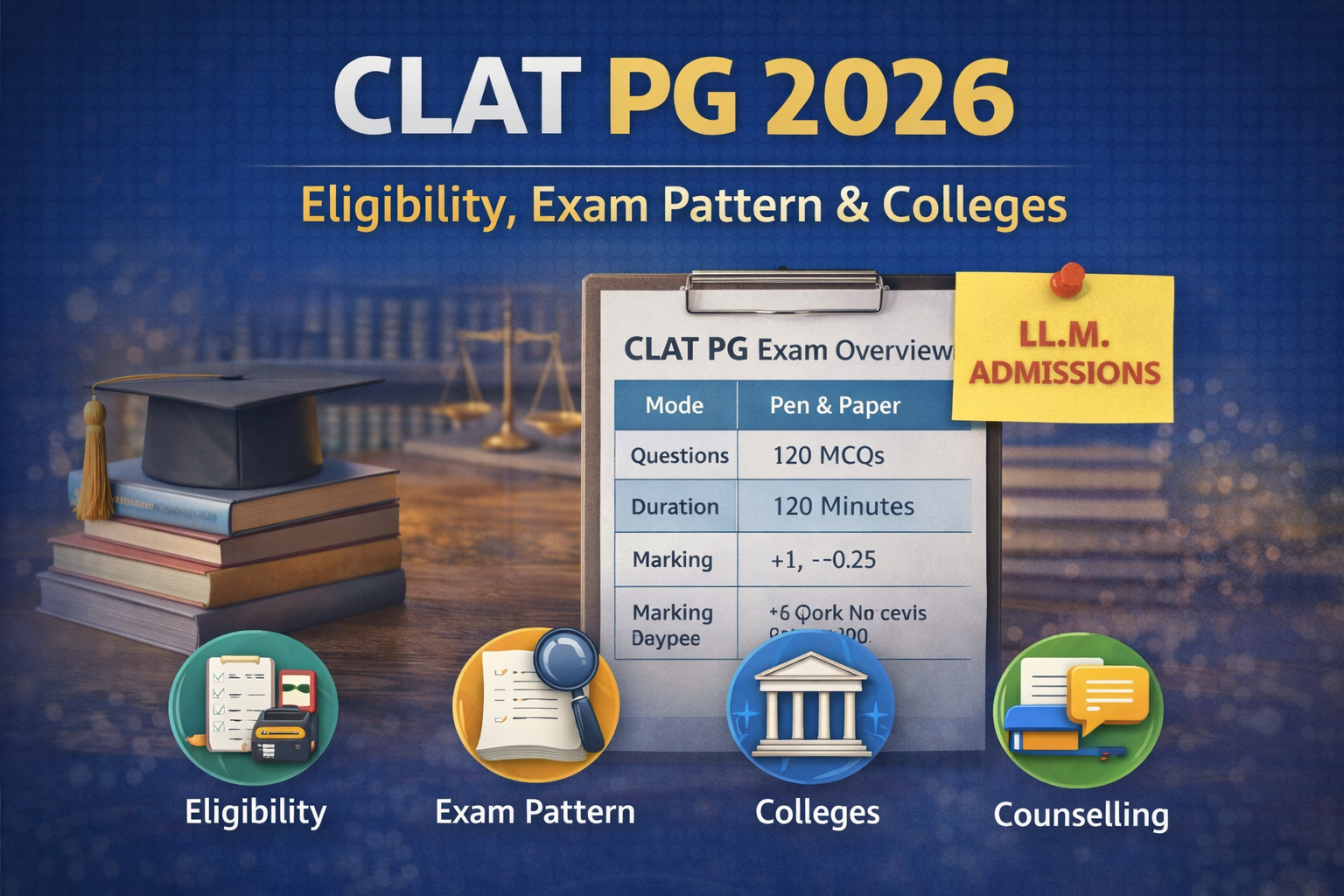
CLAT PG 2026 Exam Pattern – Overview
Key areas tested include:
- Constitutional Law
- Jurisprudence
- Administrative Law
- Law of Contracts
- Torts
- Criminal Law
- International Law
- Contemporary Legal Developments
(You can find a subject-wise weightage and preparation strategy here : CLAT PG 2026 Syllabus & Strategy)
Colleges Accepting CLAT PG 2026 Scores
Admissions throughCLAT PG 2026are offered byNational Law Universities (NLUs)for their LL.M. programmes. Some NLUs also use CLAT PG scores forPhD admissionsor specialised postgraduate courses.
Most National Law Universities (NLUs) accept CLAT PG scores for LLM admissions, with about 21 out of 26 participating, butNLU Delhiuses its own exam (AILET PG) andCNLU Patnatakes CLAT for UG but has its own LLM test.
Top NLUs like NLSIU Bangalore, NALSAR Hyderabad, WBNUJS Kolkata, and NLU Jodhpur are popular choices, requiring high CLAT ranks, while others accept lower ranks, with admission depending on rank, category, and counselling.
Each NLU has its ownseat matrix, reservation policy and counselling procedure which are published separately after the declaration of CLAT PG results.
(Check the updated NLU-wise seat matrix and LL.M. specialisations here – CLAT PG Colleges & Seat Matrix)
CLAT PG 2026 Counselling and Admission Process
After the declaration of results, the Consortium conducts acentralised counselling process. Candidates are required to register for counselling, fill in their preferences for NLUs and LL.M. programmes and participate in multiple rounds of seat allotment. Admission is finalised upon document verification and payment of the prescribed fees.
Why CLAT PG 2026 Matters for LL.M. Aspirants
CLAT PG is not merely an entrance exam but abenchmark for postgraduate legal aptitude. It plays a crucial role for aspirants aiming for:
- Academic careers and legal research
- Judicial services and higher judiciary preparation
- Policy, legislative drafting and think-tank roles
- Advanced specialisation in constitutional, corporate or international law

FAQs
1. Is CLAT PG 2026 mandatory for LL.M. admission in all NLUs?
- Yes, most NLUs admit students to their LL.M. programmes through CLAT PG, except a few institutions like NLU Delhi which conduct separate entrance exams.
2. Can final-year LL.B. students apply for CLAT PG 2026?
- Yes, candidates appearing in the final year of their LL.B. programme are eligible, subject to fulfilling qualification requirements at the time of admission.
3. Do Delhi University (DU) and Tata Institute of Social Sciences (TISS) conduct separate LLM entrance exam?
- No. Both DU LLM and TISS LLM admissions are part of the CUET PG (LLM) exam. Aspirants no longer need to appear for separate university-level tests, as CUET serves as a single, standardised gateway for these programs.
4. How many seats are available for LLM through CLAT PG?
- Around 1,500+ LLM seats across all participating NLUs.
5. Which subjects are most important for CLAT PG 2026 preparation?
- Constitutional Law, Jurisprudence, and current legal developments are particularly important, though all core law subjects should be covered comprehensively.
6. Are CLAT PG scores valid for PhD admissions?
- Some NLUs consider CLAT PG scores for PhD shortlisting, but most conduct separate research aptitude tests and interviews.