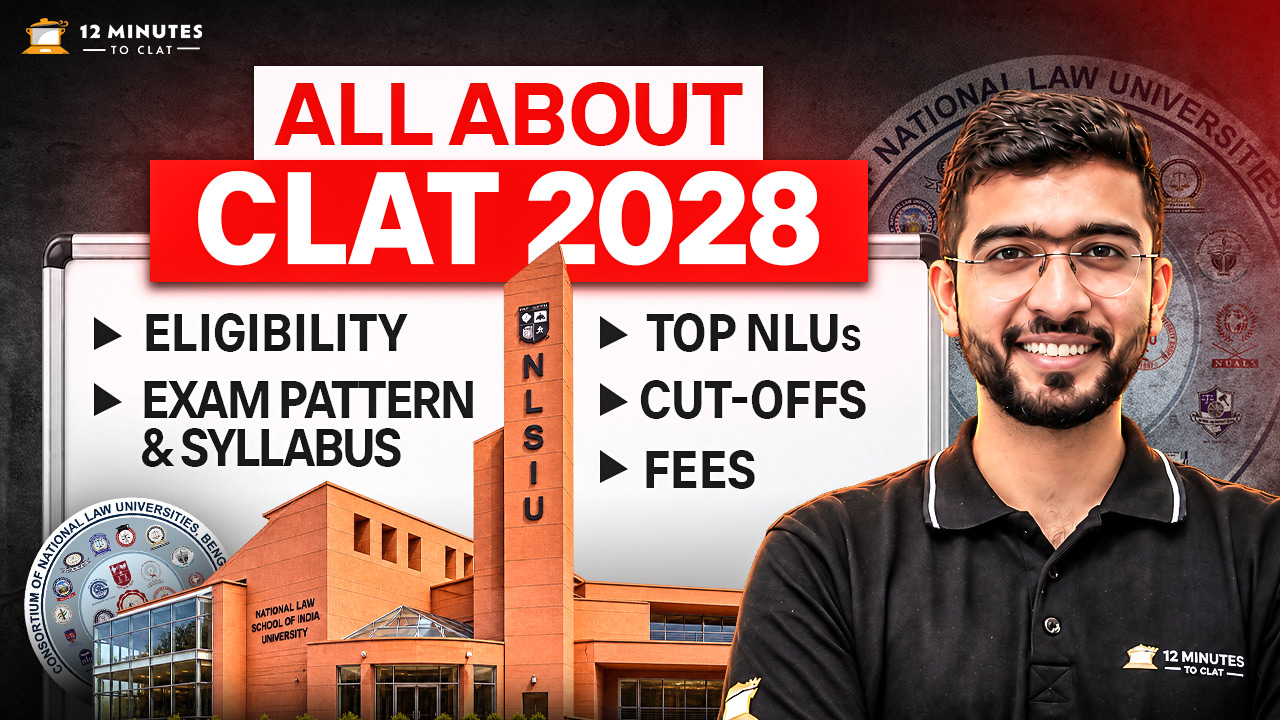

The Common Law Admission Test (CLAT) stands as a gateway in determining admissions to undergraduate and postgraduate law programs across 25 National Law Universities and numerous private institutions, conducted annually by the Consortium of National Law Universities.
The CLAT 2026 exam date is on December 07, 2025, featuring 120 multiple-choice questions (MCQs) to be completed in a span of 2 hours. For success in such a competitive entrance test, understanding the exam structure is the key to preparing the base.
The blog discusses the CLAT 2026 Syllabus, helping the students to kickstart their journey.
The CLAT 2026 examination syllabus comprises five distinct sections, each carrying different weightage and question distribution in a total of 120 questions. For each correct answer, a student receives 1 mark, and a wrong answer results in a loss of 0.25 marks.
Core Subject’s Syllabus and key Topics of the CLAT 2026
English Language
The English Language or Reading Comprehension section in the CLAT 2026 syllabus tests reading comprehension skills through passages of approximately 350 - 450 words, focusing on inference, vocabulary, and grammar.
It emphasises critical reading and interpretation skills of the students. Over the past few years, it has been one of the most scoring sections in the CLAT, as evident from the CLAT exam pattern.
True to its name, it involves comprehending the English passages and answering the questions through correct interpretation. You can check out the English language sectional course for CLAT 2026 for best preparation.
Current Affairs & General Knowledge
This section of CLAT 2026 tests the knowledge of the students and their familiarity with contemporary issues. This section tests your knowledge through news-based passages covering topics like politics, recent developments, international relations, economics, legal current affairs, etc.
The past few years have witnessed an increased focus on India-centric events. This requires students to stay updated with the monthly current affairs news. Also a sectional course GK on CA & can prove to be highly beneficial
Legal reasoning
This section tests your legal aptitude and application skills through its application-based questions on passages covering legal topics.
The section encompasses basic topics, including various concepts of criminal law, contract law, tort law, Constitution of India, among the basics.
While it also deals with some legal topics of contemporary relevance, for instance, topics of family law as noticed in CLAT 2024, which reflected current legal development, requiring in depth understanding of this section .
Logical Reasoning
Under the syllabus of CLAT 2026, logical reasoning assesses candidates' abilities to analyse, evaluate, and deduce conclusions from given passages or arguments.
The section includes diverse question types such as strengthening questions, weakening questions, finding assumptions and inferences, deducing the main idea and conclusions, etc. It requires students to read thoroughly between the lines, which evaluates critical evaluation skills.
For the same we offer a sectional course focusing on detailed understanding of this section which trains students for all sort of questions, minimizing the risk of wrong answers
Data Interpretation
It covers basic Mathematics up to the level of class 10. Majorly, the section focuses on interpreting data and solving questions based on the data given in the passage through either words or through a graphical representation.
Basic concepts of Mathematics are included in this section as a part of the CLAT 2026 syllabus.
Recent trends in the question paper: CLAT exam pattern
CLAT 2026 demands strategic preparation focused on comprehension skills and interpretation skills.
Consistent patterns favouring analytical thinking over rote memorisation, aspirants must prioritise passage-based practice and current affairs integration with legal concepts, along with proper guidance.
We are more than willing to provide students with proper guidance and support. Please use this link to explore the courses offered by 12 Minutes To CLAT and start preparing with the best.
Suggested further reads : How to prepare for CLAT 2026