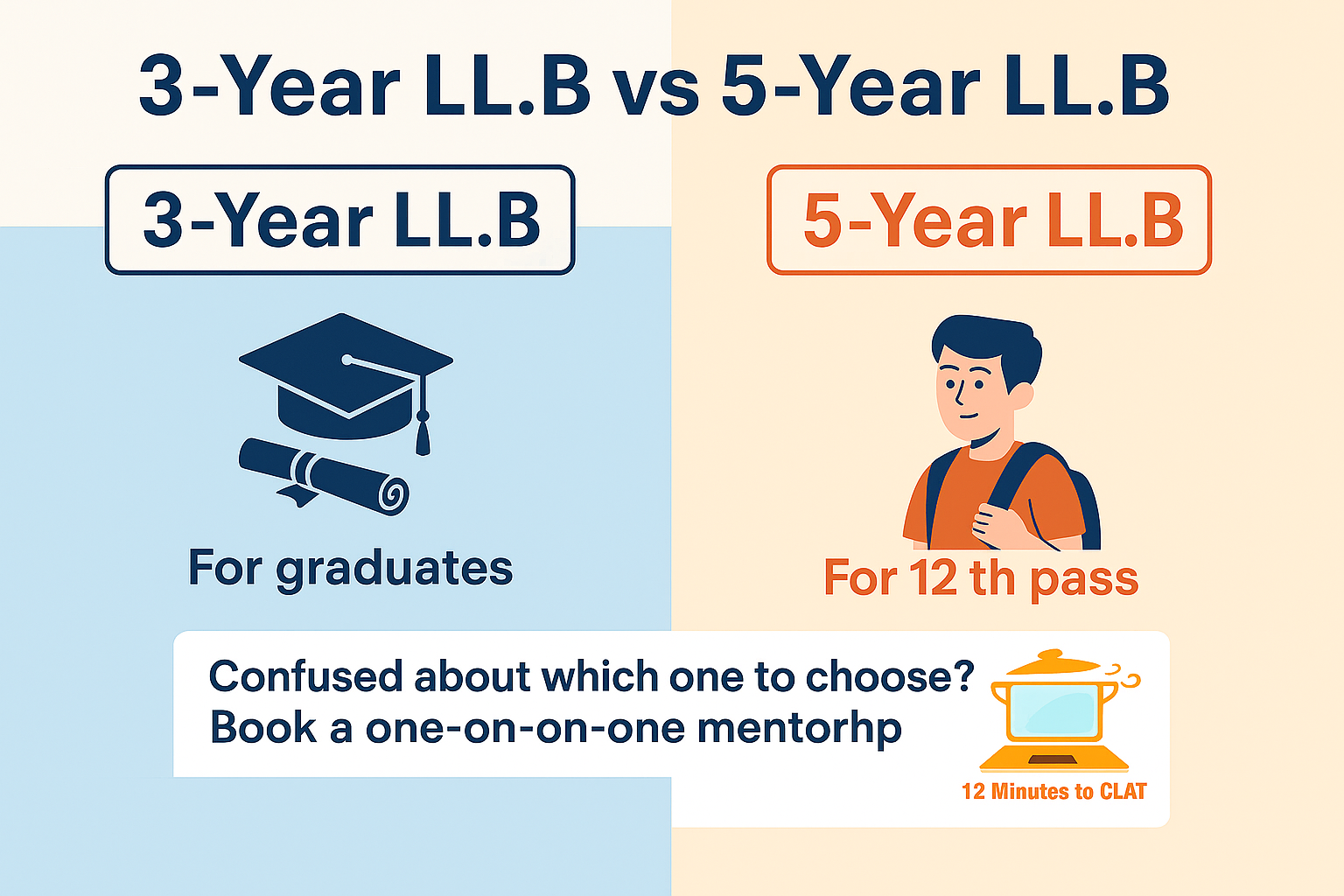
The 3-year LLB and 5-year LLB are two distinct pathways to a law degree in India, each with its own structure, eligibility, and advantages.
Confused about which LLB path to choose? Book a one-on-one mentorship session to get personalized guidance.

Feature | 3-Year LLB | 5-Year LLB (Integrated) |
Eligibility | Requires a prior undergraduate degree (BA, BCom, etc.) | Directly after 12th grade (any stream) |
Duration | 3 years (after graduation) | 5 years (integrated with BA, BBA, BSc, etc.) |
Curriculum | Focuses solely on law subjects | Mix of law and general education subjects |
Career Opportunities | Same as 5-year LLB; eligible for all law careers | Same as 3-year LLB, plus broader foundation |
Best For | Graduates, career changers, professionals | Students certain about law as a career early |
Admission | After any graduation, via entrance exams | After 12th, via entrance exams (CLAT, AILET, etc.) |
Shorter if you already have a degree; focused | Saves a year vs. separate UG+LLB; broader base | |
Cons | Requires prior degree; can be intense | Longer duration; requires early career decision |
Fees & ROI
Program | Government Colleges (per year) | Private Colleges (per year) | NLUs/Top Private (per year) | Total Cost (approx.) |
3-Year LLB | ₹3,000 – ₹70,000 | ₹50,000 – ₹5,00,000 | ₹1,00,000 – ₹5,00,000 | ₹10,000 – ₹5,00,000+ |
5-Year LLB | ₹5,000 – ₹1,00,000 | ₹1,00,000 – ₹6,00,000 | ₹2,00,000 – ₹13,00,000 | ₹50,000 – ₹15,00,000+ |
ROI Considerations:- 5-Year LLB may have higher total fees due to longer duration but saves a year compared to separate UG + 3-year LLB.
- Scholarships: Available in many government and private institutions, especially for reserved categories and meritorious students.
- Annual Fee Hikes: Many colleges increase fees by 3–10% annually.
Career & Placement Outlook
3-Year LLB
- Career Paths: Litigation, judiciary, government legal services, legal consultancy, corporate legal departments.
- Placements: Fewer structured campus placements compared to 5-year programs; most students pursue litigation, judiciary exams, or government roles.
- Top Colleges: Faculty of Law, DU; Government Law College, Mumbai; Symbiosis Law School.
- Average Starting Salary: ₹3–6 lakh per annum for fresh graduates, higher with top colleges or prior experience.
5-Year LLB
- Career Paths: All options open for 3-year LLB, plus a broader base for corporate law, academia, policy, and international law.
- Placements: Top NLUs and private colleges offer organized campus placements; median salaries at top law schools range from ₹10–20 lakh per annum.
- Top Colleges: NLSIU Bangalore, NALSAR Hyderabad, NUJS Kolkata, GNLU Gandhinagar, Symbiosis Law School.
- Placement Process: Includes internships, campus recruitment, and direct applications. Many internships convert into full-time offers.
Reddit Insights
3-Year LLB
- General Sentiment: Mixed to cautious. Many users highlight that placements are limited, especially outside top colleges like DU. Litigation and judiciary/government exams are common paths, with few campus placements.
- Advice: Target reputed colleges for better prospects. Students with no interest in litigation or government roles may find private sector placements challenging.
5-Year LLB
- General Sentiment: More positive, especially for students at top NLUs and private law schools. Better campus placements, higher salaries, and more internship opportunities.
- Comparison: Some users note that tier-2 NLUs for 5-year programs often offer better placement and exposure than most 3-year LLB colleges, except for legacy institutions like DU
Final Takeaway
Both the 3-year and 5-year LLB lead to eligibility for the Bar Council and an opportunity to practice law.
Your success will ultimately depend on the quality of the college, internships, networking, and impactful academic performance—regardless of the program you choose.
What is the main difference between 3-year and 5-year LLB?
- The 3-year LLB is for graduates and focuses solely on law subjects, while the 5-year LLB is an integrated course after 12th grade, combining an undergraduate degree with law
Can I pursue a 3-year LLB after any undergraduate degree?
- Yes, you can pursue a 3-year LLB after completing any bachelor’s degree (BA, BCom, BSc, etc.) from a recognized university.